Thursday, March 3, 2016

Kohinoor Diamond


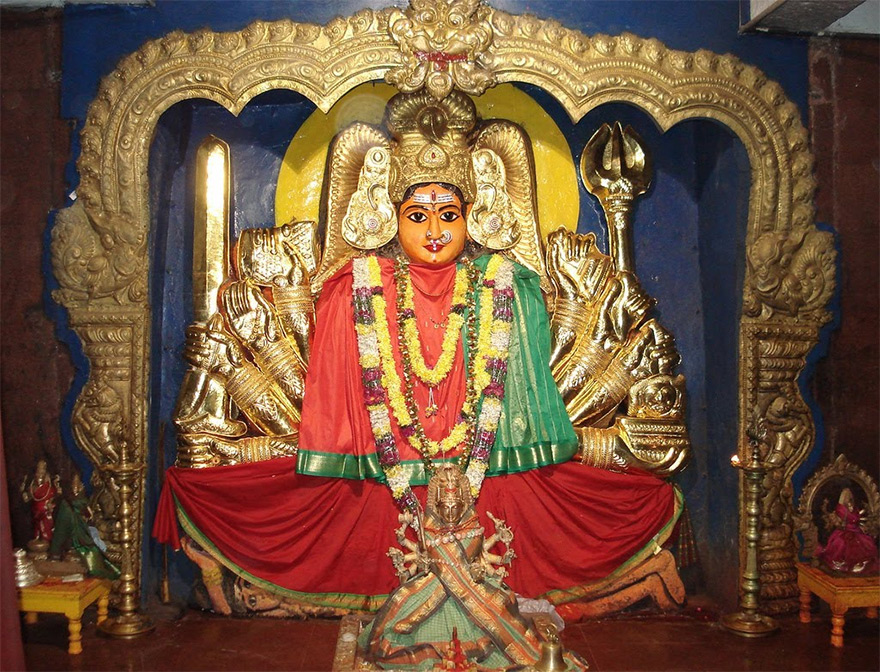
The Kohinoor Diamond in the British Crown Jewels was the Eye of Hindu Goddess of Warangal.
The Kohinoor diamond was originally installed as one of the eyes of the presiding goddess of Warangal by the Kakatiya kings. In 1323 Ghiyath al-Din Tughluq defeated the Kakatiya rulers and took the diamond from the temple. Due to this sin, Ghiyath al-Din Tughluq was murdered just one year latter in a conspiracy by his own son. The cursed jewel was passed on to various kings throughout history, always bringing great misfortune and death.


Goddess Badhrakali of Warangal, the true owner of Kohinoor diamond.

In 1839, on his deathbed, Maharaj Ranjit Singh of Punjab donated the Koh-i-noor diamond to Lord Jagannath of the Puri Jagannath Temple in Orissa, but as he died the diamond was refused to be transferred to the temple by the British administrators. Thus for a second time the diamond had been stolen from a Hindu temple.
In 1850, the jewel was stolen from India and delivered to the British monarchy by force. Due to the curse of the diamond, the British empire also began to collapse shortly after it acquired the Kohinoor diamond. Today this same Kohinoor diamond is the crown jewel of the British empire, to be worn by the Queen of England. There have been many suggestions that the diamond should be returned to India.
The Jewel in the Crown: The Curse of the Koh-i-Noor Diamond
Its 750-year history is peppered with tales of murder and treachery. Now, secret papers recently released have added another twist to the 186-carat gem’s colourful history.
Some 155 years ago, a nine-year-old boy carrying a silk cushion was brought before Queen Victoria. His job was simple: to present Britain with the most glittering and symbolic spoil of its war to subjugate the Indian sub-continent.The boy was Duleep Singh, the last Sikh ruler of the Punjab, and the prize his new imperial masters had made him travel 4,200 miles to deliver was the Koh-i-Noor diamond – the mysterious and terrible stone of emperors.
The 186-carat gem, whose name means Mountain of Light in Persian and was described by one Mughal emperor as being “worth half the daily expense of the whole world”, carried with it a curse and a 750-year bloodstained history of murder, megalomania and treachery.
But its passage to Britain in 1851 carried a different meaning: it was a carefully choreographed exercise in establishing the majesty of the Raj – and the one-way flow of riches from it.
Lord Dalhousie, the Governor General of India who was credited with masterminding the subjugation of the Punjab in the Second Sikh War in 1849 and subsequent surrender of the diamond, ordered that Prince Duleep, London’s new puppet Maharajah of Lahore, deliver the Koh-i-Noor in person.
The diamond was war booty and its delivery was to be a spectacle carried out in much the same manner as the tribute paid by defeated enemies of Egyptian pharaohs and Roman emperors. It was the centrepiece of the Great Exhibition of 1851, attracting thousands of visitors.


After the assassination of Nadir Shah, another victim of the curse, the diamond passed through the hands of his successors, each dethroned and ritually blinded, until it was passed in return for sanctuary to Ranjit Singh, the Lion of Lahore, self-declared ruler of Punjab and father of Duleep Singh.
Within 40 years, the stone had passed into the possession of Lord Dalhousie after a military campaign every bit as ruthless and blood-soaked as those which had previously been fought for possession of the Koh-i-Noor. What followed was a process of the Anglicisation of the diamond.

A spokesman for the High Commission in London said: “The Indian government has a legitimate claim. We hope to resolve the issue as soon as possible.”
But behind closed doors in Whitehall, it is unlikely that the position outlined 30 years ago has changed.
Epilogue: On 21 February 2013, while visiting India, David Cameron, the UK Prime Minister, stated that it would be illogical to return the diamond to India. He further stated, “I certainly don’t believe in returnism, as it were. I don’t think that’s sensible.” We should remember that his country forced India to hand over this priceless diamond during the colonial era. Cameron is keen to tap into India’s economic rise, but says he is “anxious to focus on the present and future rather than reach back into the past”.

Final verdict: Finders keepers, Loosers weepers.


Krishnamachari Santhanam

Mylapore Kapaleeswarar Temple


One of the sacred shrines in Tamil Nadu is Arulmigu Kapaleeswarar Temple in Mylapore, in Chennai City.It is a Siva Temple, and the name of the Lord is ARULMIGU KAPALEESWARAR. The name of the Goddess is ARULMIGU KARPAGAMBAL.It is a lovely temple with a Stately Spire or ‘Gopuram’ as it is called. There is a big tank on its West. The temple and the tank are surrounded by Broad streets on the four sides. The view of the temple and the tank is picturesque.

Mylapore is on the sea coast and the shore is away by half a mile of thickly populated residential area.

The Legend Behind The Temple


The name Mylapore is derived from the legend that the Goddess Uma worshipped Siva in the form of a peacock (or mayil in Tamil). We can see a representation of this legend on stone in a small Shrine under a Punnai tree (Sthala Vriksha) in the Courtyard of the temple.

The temple's name is derived from the words kapalam (head) and eeshwarar an alias of lord Shiva. According to the Puranas, during the meeting of Brahma and Shiva at top of Mount Kailash Brahma failed to show the due respect to Shiva. Due to this, Shiva plucked of one of Brahma's heads (kapalams). In an act of penance, Brahma came down to the site of Mylapore and installed a Lingam to please Shiva. This place is known as Sukra Puri, Veda Puri, among many other names including “Kailaye Mayilai and Mayilaye Kayilai “which means this place is equal to kailash. Goddess Karpagambal, a form of Shiva's consort Parvati, due to a curse became a pea-hen and did penance here to get back her original personality. Shiva's son Murugan received the spear (Sakthi Vel) for the destruction of a demon from Parvati here. Brahma had worshipped here to get rid of his ego and get back his power to create. The four Vedas have worshipped here. Sukracharya worshipped the Lord here and got back his lost eye. Rama has worshipped here and won the war against Ravana and brought back Sita from Lanka. The daughter of Sivanesa Chettiar Angam Poompavai got her lost life here by the powers of Thirugnana Sambandar. Vayilar Nayanar, a saiva saint, attained salvation here and Mylapore is also the birth place of Thiruvalluvar who wrote Thirukkural. In Thevaram special mention is made about the beautiful Madaveedhi as “Malgun Mathri Thavazhum Maada Veedhi Mylappil Ullar”. Thiruganana Sambandar, Arunagirinathar have sung the glory of Karpagambal, Singara Velar. The 10 day festival during March / April is a treat to watch and Arubathu Moovar festival is attended by lakhs of devotees every year.


Also the charriot festival or Ther as called in Tamil is very famous in Mylapore.


During the Tamil month of Panguni, the traditional brahmotsavam (annual festival) takes place when the entire neighborhood comes alive with a mela (carnival)-like atmosphere. Since this month corresponds to the mid-March to mid-April duration, the Kapaleeshwarar temple celebrates the nine day-long as Panguni Peruvizha (Spring festival). The festival starts with Dwajarohanam (flag hoisting), includes the therotsavam, (Tamil, ther, "car/chariot"; utsavam, "festival"), Arupathimoovar festival and concludes with the Tirukkalyanam (Marriage of Kapaleeswarar & Karpagambal). In Brahmotsavam, the idols of Kapaleeshwarar and Karpagambal are decorated with clothes and jewels, are mounted on a vahana, and then taken around the temple and its water tank in a pradakshinam (a clockwise path when seen from above). This is repeated with different vahanas over the next nine days. The more important of the individual pradakshinams are the Athigara Nandhi on the third day, the Rishaba Vahanam on the midnight of the fifth day, the ther (about 13 meters in height and pulled by people) on the seventh morning, and the Arupathimoovar festival on the eighth day.

The Arupathimoovar festival is the most important procession. It is named after the sixty-three Nayanmars who have attained salvation by their love & devotion to the all-compassionate Lord Shiva. All sixty-three Nayanmar idols follow the Kapaleeshwarar idol on this procession. During the car festival, Kapaleeshwarar is depicted holding a bow while seated on a throne, with his consort Karpagambal alongside. Brahma is depicted riding the Chariot. The chariot is decorated with flowers and statues, and there are huge gatherings of devotees to pull the chariot.

Krishnamachari Santhanam

Wednesday, March 2, 2016

Bramha Temple, Kumbakonam


Bounded by the River Kaveri on the north and the Arasalar River on the south, the town of Kumbakonam is 40 km. northeast of Thanjavur, and 60 km. inland from the coast of Tamil Nadu. It is home to the Shri Vedanarayana Perumal Temple, which is a very interesting example of Brahma worship.

The most significant to note is the hidden fourth face of Bramha , which is actually that of Gayathri Devi. She completes the incomplete kandith face of Bramha to make him eligible to do the yagna. Darshan of this face of Gayathri gets sakshathkar for a sadhaka.

There are three sanctum sanctorum in the temple, the one for Lord Brahmma with His consorts Mother Saraswathi and Mother Gayatri in a standing posture seeking the blessings of Lord Vedanarayana Perumal, the second for Lord Veda Narayanaperumal accompanied by His consorts Mothers Sridevi and Bhoodevi and the third is for Lord Yoga Narasimha with His two consorts. Thus, the devotee can have the darshan of three Lords in the temple.


The temple conducts Brahmma Sankalpa Puja educational and trade progress boons.  Devotees perform special pujas for Lord Brahmma and Mothers Saraswathi and Gayatri before admitting children to school.  Special pujas are performed during Thursdays.  Pujas are performed for Mother Mahalakshmi on Fridays and Perumal on Saturdays for relief from debt burdens.  Homas are performed for Lord  Yoga Narasimha by devotees for longevity on their 60th, 70th and 80th birthday occasions.

While some call this a Visnu temple, it is properly considered a Brahma temple, and has been categorized as such for many years. Kumbakonam appears on all of the 'short lists' of rare Brahma temples in India. It is known by various names: Vedanarayana Perumal Temple, Brahnam Kovil, and the Bramman Temple.

The temple is located beside the Mahamagha tank, in what is now called Pattunoolkara (silk weaver) Street. Of the 17 major temples in Kumbakonam, 12 are Saivite, 5 are Vaisnava, and only the Vedanarayana Perumal is dedicated to the worship of Brahmadeva. In general, the temples on the outskirts of Kumbakonam are relatively modern, having been constructed by the Naik kings, but the temples in the center of Kumbakonam are ancient, going back to the Chola period. Sri Vedanarayana Perumal Temple falls into the latter category. During the 7th century, Kumbakonam was the capital of the Cholas.

There is a popular sloka addressed to Guru-Teacher seeking wisdom running

Gurur Brahmma Gurur Vishnu, Gurur Devo Maheswarah
Guru Sakshath Param Brahmma Thasmai Sri Gurave Namah

covering the three Lords.  There are many stories about Brahmma, that he took the form of a swan to find the head of Lord Shiva but failed.  To hide the defeat, He lied that he had seen Shiva’s head.  Also, as Mother Parvathi mistook Brahmma for Shiva as both had five heads then, to avoid the confusion, one head of Brahmma was removed reducing to four.  Thus, worship of Brahmma was discontinued.  But according to philosophy, one born should finally reach the Creator Himself.  Brahmma is the Creator and also He is the one protecting the Vedas by chanting them by His four tongues.  He enjoys His own importance in the scriptures.   Among the few such temples dedicated to Him, the Brahmma temple in Kumbakonam is one.  He graces here the devotees with His consorts Mothers Saraswathi and Gayatri.

It is widely common that many are proud of their high learning barring a few and Lord Brahmma was no exception to this mentality.  He thought that He alone can create which Lord Shiva and Vishnu cannot.  Knowing this, Lord Vishnu sent a ghost (Bhooda) to Brahmma who trembled on seeing the creature.  He ran to Lord Vishnu saying that a ghost not created by Him was threatening and sought protection.  Lord Vishnu said that it was created by Him to check his pride and that he would also forget the art of creation.

When begged for a remedy, Lord Vishnu suggested that he go to Earth and perform penance.  Brahmma chose this place, Kumbakonam that stays stable even after the destroying Pralaya floods.  All the Devas assisted Brahmma in his penance.  Pleased with Brahmma’s penance, Lord Vishnu appeared before him, taught the Vedas and reinstated Brahamma to his earlier status.  Perumal became Lord Veda Narayana Perumal and Mother Vedavalli.  To facilitate the final bath of Brahmma and the Devas after the penance, Perumal created a river with His club known as Hari Sollaru which later days faced changes and it is Arasalaru today.

There are a number of famous pastimes involving Lord Brahma that are associated with this temple. When Lord Brahma was gathering the tools for his works of creation, most notably the Amritham, he kept his paraphernalia in the Kumbam, the pot which contained seeds of all the life forms. These Brahmadeva put to use after the Pralaya, when the material universe was annihilated by flood at the end of the age.Since Bramha kept the pot/Kumbha in this place , this place got the name Kumbhakonam.


Here on top you can have darshan of the Kumbakonam Mahamagam tank.


Krishnamachari Santhanam

Tuesday, March 1, 2016

Madurai Meenakshi Amman Temple


Meenakshi Amman Temple is a historic Hindu temple located on the southern bank of the Vaigai River in the temple city of Madurai, Tamil Nadu, India. It is dedicated to Parvati, known as Meenakshi, and her consort, Shiva, here named Sundareswarar. The temple forms the heart and lifeline of the 2,500-year-old city of Madurai and is a significant symbol for the Tamil people, mentioned since antiquity in Tamil literature though the present structure was built between 1623 and 1655 CE. It houses 14 gopurams (gateway towers), ranging from 45–50m in height. The tallest is the southern tower, 51.9 metres (170 ft) high, and two golden sculptured vimanas, the shrines over the garbhagrihas (sanctums) of the main deities.  There are an estimated 33,000 sculptures in the temple. It was on the list of top 30 nominees for the "New Seven Wonders of the World". The temple is the most prominent landmark and most visited tourist attraction in the city. The annual 10-day Meenakshi Tirukalyanam festival, celebrated during April and May, attracts 1 million visitors.

The Meenakshi temple is believed to have been founded by Indra (king of Deva celestial deities).While he was on a pilgrimage to atone for his misdeeds. He felt his burden lifting as he neared the swayambu lingam (self formed lingam, a representation of Shiva used for worship in temples) of Madurai. He ascribed this miracle to the lingam and constructed the temple to enshrine it. Indra worshipped Shiva, who caused golden lotuses to appear in the nearby pool.[15] Tamil literature speaks of the temple over the last two millennia. Thirugnanasambandar, the famous Hindu saint of Saiva philosophy, mentioned this temple as early as the 7th century, and described the deity as Aalavai Iraivan. The temple is believed to have been sacked by the infamous Muslim invader Malik Kafur in 1310 and all the ancient elements were destroyed. The initiative to rebuild the structure was taken by first Nayak king of Madurai, Viswanatha Nayak (1559–1600).
Early in the 14th century, disputes arose over the succession to the Pandya throne. Taking notice of these events, Ala-ud-din of Delhi, dispatched his general, Malik Kafur, in 1310 to invade the weakened kingdom. Malik Kafur marched south, ransacking kingdoms on the way and causing enormous changes to the political configuration of central and Southern India. He marched into Madurai, sacking the town, paralysing trade, suppressing public worship, and making civilian life miserable. The great Meenakshi temple with its fourteen towers was pulled down, destroying the nearby streets and buildings, and leaving only the two shrines of Sundaresvara and Meenakshi intact. The events are controversial: as another account describes them,

The above is the famous sculpture of Meenakshi Kalyanam sculpted in Granite.


Golden Vimana of Meenakshi sanctum sanctorum.

Krishnamachari Santhanam

Monday, February 29, 2016

Hampi


Spread across 25 kms, once the capital of the prosperous kingdom of Vijaynagar, the ruins of Hampi are now the listed under the UNESCO World Heritage sites. In around 1500 A.D. Vijaynagar had 500,000 inhabitants, probably making it the second largest city in the world after Peking-Beijing and twice the size of Paris back then! It was later captured and destroyed by Muslim armies and abandoned ever since.

Hampi — traditionally known as Pampa-kshetra, Kishkindha-kshetra or Bhaskara-kshetra — is derived from Pampa, which is the old name of the Tungabhadra River (also Pampa was Lord Bhrumah's daughter, who was later married to Lord Shiva) on whose southern banks the city is built.[ The name "Hampi" is an anglicized version of the Kannada Hampe (derived from Pampa). Over the years, it has also been referred to as Vijayanagara and Virupakshapura (from Virupaksha, the patron deity of the Vijayanagara rulers).


Virupaksha Temple known as the Pampavathi temple, it is an ancient temple situated in the Hampi Bazaar. It predates the founding of the Vijayanagara empire. The temple has a 160-foot (49 m) high tower at its entrance. Apart from Shiva, the temple complex also contains shrines of the erotica statues Bhuvaneshwari and Pampa.


The above is the Picture of the beautiful stepped tank near the underground Shiva temple in Hampi.

Krishnamachari Santhanam


Sunday, February 28, 2016

Martand Sun Temple Jammu & Kashmir


Martand Sun Temple


Located on a plateau in Anantnag, Jammu & Kashmir, Martand Sun Temple is dedicated to the Sun god built by the King of Karkota Dynasty in the early 8th century AD. The temple was destroyed by Islamic ruler Sikandar Butshikan in the early 15th century, and it has stood in ruins ever since. The placement of the Temple enables a panoramic view of the beautiful Kashmir Valley. The Shrine is situated in the centre while the remains of the other structures are scattered around the premise. The Martand Sun Temple is one of the important archaeological sites in India.

According to local legend, Surya, the Sun God of Hindu Mythology was born of Aditi from a lifeless egg called Martand. Aditi was the wife of Kashyap, the saint from whom Kashmir probably takes its name. Surya was her 13th child, the spring of Mattan is attributed to this legend. Lord Vishnu Surya has been worshipped in his Martand manisfestation. The modern name of the village Mattan seems to has evolved from the Sanskrit Martand (mart = dead / and <— anda = egg) with the passage of time.

This temple was Martand. Though Kalhana, Kashmir Historian, has given contradictory references regarding the founder of Martand. For example at one place, he has mentioned that King Randitya founded Martand. And in another book he has mentioned the name of famous warrior King Lalita Ditya Mukta Pida. The construction of the world famous Martand is usually ascribed to Lalita Ditya Mukta Pida. The king appeared to be a worshiper of Sun as an all pervading phenomenon. He also offered to the Diety “the territory of Kanyakubja (Kanauj) together with the villages.” The fact was that Kanauj King Yasho Varman had suffered defeat at his hands and this had made his task easier to march on to the bay of Bengal on Turning back, he passed through Mysore and Konkan territory where he met with little or no resistance. So his power and valour naturally would have made him 'Lalita Ditya Mukta Pida' (swelled with pride). And he paid homage to the fierce luminary by founding Martand (Sun Temple). It is now in ruins. Only some parts have survived but its pictures have been preserved in most of the books written on Kashmir.

This is another pricess Indian heritage destroyed by the Mughals.

Krishnamachari Santhanam


Wednesday, November 11, 2015

Manthras and Mind power


Imagine that you are standing on the bank of a river and you hear the current as it flows. If you follow 

the river upstream, you will come to its origin. There, you will find that there is no sound. In the same way, a mantra leads the mind to the silence within. That state is called “soundless sound.” Each mantra will make a different form. You have to go to the source within, from which that sound comes.


Manthras and the mind are closely related. Many Manthras mould the mind in its subtle form. The sound vibrations the Manthras generate mould the subtle aspects of the Mind. Many forms of God are mind forms too. No wonder the originator of a manthra the sage is called Manthra Drishta. The seer of the Manthra. So he is not the hearer of the Manthra but the seer. This explains a lot. Even Prophet Mohammad is said to have seen the visual descent of the Quran.


Sanathana Dharma had known this truth for ages and has utilised it effectively to condition mankind towards perfection. In Hinduism many forms of worship can be substituted by mental worship. Snanam( Ritual Bath), poojanam ( Worship by flowers etc) , Vandhanam ( Bowing) etc can take mental forms. So in Hinduism there is no excuse to skip a worship or prayer even if water or flowers are not physically available. Remembrance is most important.


For instance, take Ganga Snanam during Deepavali. Ganga is verily said to penetrate into all waterbodies on Deepavali , so all believers do take a Ganges dip! Plus, there is a sloka which verily has the power to bring all the holy waters verily into your shower! Beat That!


" Gange ca Yamune devi

Godavari Sarasvathi

Narmadhe Sindhu Kaveri

Jalesmin Sannidhim Kuru"


Just reciting this before Bath verily makes your physical Bath a Divine one. What a way to infuse Desh Bakthi also. Constant remembrance of your countries holy water bodies does increase your love for your mother land.


Even taking the Ganapathi pooja which is verily the shub Arambh ( Auspicious beginning ) of all rituals. Ganapathy , the auspicious divine form is the most easy to draw or Sculpt. Priests do not wait for a moorthy ( Image ) of a Ganesha. He just Rolls a some Turmeric paste in his palm and makes an image of Ganesha, which normally is only a clump or pyramidical in shape and recites the following Manthra:


" Asmin Bhimbe Maha Ganapathim Avahayami"


By this he is infusing energy into the pyramid or invoking Ganesha in it. Such a simple Prana Prathishta!


So let us take a little time to educate our youngsters on these powerful tools of positivity. The current youngsters are enamoured by Power of positive thinking books available in the market. Little do they know that these are available at their doorsteps, only needs little effort to know the treasure they are missing out on.


Krishnamachari Santhanam